

Research
Technical Documentation for the Twelfth American School District Panel Survey
Mar 24, 2026
Findings from the American School District Panel
ResearchPublished Mar 24, 2026

Photo by FG Trade/Getty Images
School districts continue to suffer in the aftermath of the coronavirus disease 2019 (COVID-19) pandemic. In addition to an acceleration of a longer-term decline in teacher satisfaction (Baker and Koedel, 2025; Kraft and Lyon, 2024; Steiner, Schwartz, and Diliberti, 2022), resignations and retirements among teachers and principals spiked nationally in the United States and in several states following the 2021–2022 school year (Barnum, 2023; Diliberti and Schwartz, 2023). Since 2022, teacher well-being appears to have risen and stabilized after pandemic-era lows (Kurtz, 2024; Steiner et al., 2025). And yet, 16 percent of teachers still reported intentions to leave their jobs in the 2024–2025 school year (Steiner et al., 2025).
Districts and education policy researchers continue to wonder whether educator turnover rates will ultimately return to, or fall below, prepandemic levels. In this report—which is an update of our prior research on this topic (Diliberti and Schwartz, 2023; Diliberti and Schwartz, 2024; Diliberti and Schwartz, 2025)[1]—we add a fifth school year (2024–2025) to our annual tracking of district-reported national turnover rates for public school teachers and principals.[2] Although our data are based on district-reported teacher and principal resignations as opposed to objective administrative data, RAND’s work tracking educator turnover rates fills a critical gap in national data that are available on this topic.[3] This report is part of a series that provides brief analyses of district leaders’ viewpoints on topics of immediate interest to policymakers, practitioners, and researchers.
The newest data presented in this report come from the fall 2025 American School District Panel (ASDP) survey. We combine these fall 2025 survey data with those from prior ASDP surveys administered in the fall of each preceding school year. Our annual surveys ask districts to estimate what percentages of their teachers and school principals retired or resigned in the previous school year, which we then average. We used districts’ answers to construct national estimates of educator turnover, which we define as the estimated average percentage of teachers and principals who leave the profession voluntarily through retirement or resignation. All turnover estimates that we discuss in this report, including prepandemic estimates, are constructed from districts’ responses to our ASDP surveys. Differences across time points should be interpreted with caution as they may reflect uncertainty associated with survey estimates.
According to reports from ASDP districts, the rate of teacher turnover nationally spiked in the 2021–2022 school year to 4.3 percentage points above prepandemic levels (see Panel A in Figure 1). This ASDP district–reported national spike was later confirmed by administrative data from multiple states (Barnum, 2023; Bastian and Fuller, 2024; Camp, Zamarro, and McGee, 2024; Clark, 2023; Fuller, 2023; Hamidu, 2023; Knight et al., 2023).


The top line chart shows how the percentage of teachers who retired or resigned changed over time, including before and during the COVID-19 pandemic.
The lower line chart displays the percentage of principals who retired or resigned across the same time period.
NOTE: This figure depicts response data from the following survey questions: “What percentage of your [teachers or school principals] retired or resigned at any point during the [numeric school year] school year? Include those who left during the school year or at the end of it.” We posed this question in fall 2025 about the 2024–2025 school year (n = 315), in fall 2024 about the 2023–2024 school year (n = 285), in fall 2023 about the 2022–2023 school year (n = 229), and in fall 2022 about the 2021–2022 school year (n = 295). In summer 2021, we posed the following questions: “What was the typical percentage of your [teachers or school principals] who retired or resigned annually prepandemic?” (n = 279) and “What percentage of your [teachers or school principals] retired or resigned at the end of the 2020–2021 school year?” (n = 278). For all questions, respondents were asked to enter a percentage into a text box. Panels A and B present the average turnover rate reported by districts. SY = school year.
Also shown in Panel A of Figure 1, ASDP district leaders’ estimates suggest that this elevated teacher turnover during the pandemic began to ease in the 2022–2023 school year and continued to decline in the 2023–2024 school year, falling from an average of 9.1 percent to 7.2 percent of teachers retiring or resigning—a decrease of nearly 2 percentage points. Our most recent data from the 2024–2025 school year show that teacher turnover continues to trend downward, although at a somewhat slower pace, to an average of 6.7 percent of teachers retiring or resigning at some point during the school year (only about half a percentage point less). Still, this brings the average turnover for teachers much closer to the prepandemic level of 5.7 percent, at least according to district reports.
Administrative data from two states (North Carolina and Arkansas) further support districts’ estimates that teacher turnover began to recover in the 2022–2023 school year following a spike in 2021–2022 (Bastian and Fuller, 2024; Camp, Zamarro, and McGee, 2024). However, we were not able to identify any data sources that have published more-recent teacher turnover rates to confirm or refute districts’ estimates for the 2023–2024 or 2024–2025 school years.
As shown in Figure 1, the national trend in turnover for principals looks slightly different from that for teachers, largely because of a lower prepandemic turnover rate and a higher pandemic peak turnover rate.[4]
As shown in Panel B of Figure 1, ASDP district leaders’ estimates of principals retiring or resigning indicate a large drop from the pandemic peak average of 16 percent during the 2021–2022 school year to an average of 9.2 percent during the 2022–2023 school year. Since then, principal turnover rates have slowly continued a downward trend, with districts estimating, on average, 8.5 percent of principals leaving in the 2023–2024 school year (a little more than half a percentage point less than the prior year) and 8.2 percent of principals leaving in the 2024–2025 school year (a difference of less than half a percentage point from the prior year).
At least according to district reports, principal turnover in the 2024–2025 school year remains higher than prepandemic levels, although the downward trend is a promising sign that turnover rates have largely recovered from pandemic times.
Before the COVID-19 pandemic began, urban districts reported higher teacher turnover rates than their nonurban peers (see Table 1). During the pandemic, teacher turnover rates rose across all types of districts, as shown in Figure 2. However, the teacher turnover rate rose most sharply in urban districts, which expanded the preexisting gaps in teacher turnover rates by district locale. The same pattern was not apparent among principals (see Table 1).
| Educator and Time Frame | All Districts (%) | Locale | |||
|---|---|---|---|---|---|
| Urban (%) | Suburban (%) | Rural (%) | |||
| Teachers | |||||
| Prepandemic | 5.7 [5.0, 6.3] | 8.6 [6.1, 11.1] | 4.5 [3.7, 5.3] | 5.8 [4.9, 6.7] | |
| SY 2020–2021 | 6.4 [5.7, 7.2] | 8 [5.9, 10.0] | 5.4 [3.9, 6.9] | 6.7 [5.7, 7.7] | |
| SY 2021–2022 | 10 [8.5, 11.5] | 14.1 [10.8, 17.5] | 8.1 [6.5, 9.6] | 10.4 [8.4, 12.5] | |
| SY 2022–2023 | 9.1 [7.8, 10.5] | 13.1 [9.6, 16.5] | 7.4 [5.2, 9.5] | 9.4 [7.6, 11.2] | |
| SY 2023–2024 | 7.2 [6.5, 7.9] | 8.6 [6.8, 10.4] | 6.8 [5.4, 8.2] | 7.2 [6.2, 8.1] | |
| SY 2024–2025 | 6.7 [6.0, 7.5] | 11.1 [9.5, 12.7] | 5.9 [5.1, 6.8] | 6.6 [5.6, 7.6] | |
| Principals | |||||
| Prepandemic | 3.3 [1.9, 4.7] | 5.9 [3.5, 8.3] | 3.8 [0.3, 7.3] | 2.7 [1.2, 4.2] | |
| SY 2020–2021 | 6.2 [4.3, 8.2] | 5.9 [3.4, 8.5] | 2.6 [1.0, 4.3] | 7.9 [4.9, 10.9] | |
| SY 2021–2022 | 16 [11.4, 20.5] | 4.9 [2.0, 7.7] | 7 [3.3, 10.6] | 20.6 [14.2, 27.1] | |
| SY 2022–2023 | 9.2 [6.2, 12.3] | 8.1 [5.5, 10.7] | 3.7 [1.8, 5.6] | 11.2 [6.8, 15.6] | |
| SY 2023–2024 | 8.5 [6.1, 10.9] | 7.3 [5.2, 9.4] | 5.9 [3.3, 8.5] | 9.6 [6.3, 12.9] | |
| SY 2024–2025 | 8.2 [5.4, 11.0] | 7 [3.3, 10.6] | 6.4 [3.0, 9.8] | 8.9 [5.1, 12.7] | |
NOTE: This table displays response data from the following survey questions: “What percentage of your [teachers or school principals] retired or resigned at any point during the [numeric school year] school year? Include those who left during the school year or at the end of it.” We posed this question in fall 2025 about the 2024–2025 school year (n = 315), in fall 2024 about the 2023–2024 school year (n = 285), in fall 2023 about the 2022–2023 school year (n = 229), and in fall 2022 about the 2021–2022 school year (n = 295). In summer 2021, we posed the following questions: “What was the typical percentage of your [teachers or school principals] who retired or resigned annually prepandemic?” (n = 279) and “What percentage of your [teachers or school principals] retired or resigned at the end of the 2020–2021 school year?” (n = 278). For all questions, respondents were asked to enter a percentage into a text box. The table presents the average turnover rate reported by districts. Numbers in brackets represent 95-percent confidence intervals.
By the 2021–2022 school year, urban districts reported a teacher turnover rate of 14.1 percent compared with 8.1 percent in suburban districts. Since then, reported teacher turnover in urban districts declined to 8.6 percent in 2023–2024, but, in this most recent school year, urban districts reported 11.1-percent turnover. As of the 2024–2025 school year, teacher turnover in urban districts was significantly and substantively higher than turnover in nonurban settings. This means that the 0.5-percentage point overall decrease in estimated teacher turnover appears to be driven by suburban and rural districts. Although previous increases in estimated teacher turnover rates appear to be attributable to teaching conditions brought on by the pandemic, it is not clear whether other factors (such as teacher retirements linked to enrollment declines) may be contributing to these ongoing disparities.
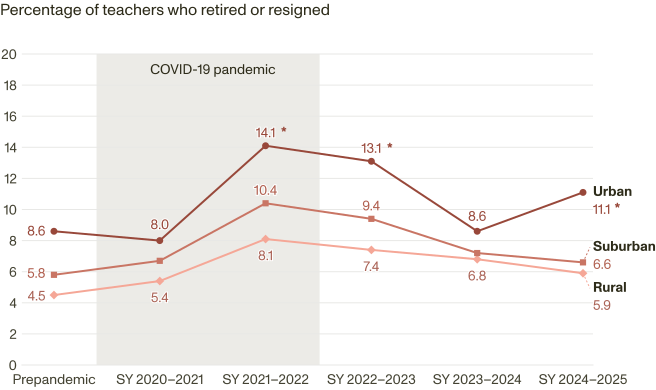
The figure is a line chart showing how the percentage of teachers who retired or resigned changed by school year and by district locale (urban, suburban, rural). The period of the COVID-19 pandemic spans school years 2020–2021 through 2021–2022.
NOTE: This figure depicts response data from the following survey questions: “What percentage of your teachers retired or resigned at any point during the [numeric school year] school year? Include those who left during the school year or at the end of it.” We posed this question in fall 2025 about the 2024–2025 school year (n = 315), in fall 2024 about the 2023–2024 school year (n = 285), in fall 2023 about the 2022–2023 school year (n = 228), and in fall 2022 about the 2021–2022 school year (n = 295). In summer 2021, we posed the following questions: “What was the typical percentage of your teachers who retired or resigned annually prepandemic?” (n = 279) and “What percentage of your teachers retired or resigned at the end of the 2020–2021 school year?” (n = 278). For all questions, respondents were asked to enter a percentage into a text box. Figures present the average turnover rate reported by districts. Data labels are rounded to the nearest tenths place. Numbers with an asterisk (*) indicate a significant difference between that subgroup and the other subgroups (i.e., urban versus nonurban schools) with a p-value of less than 0.05.
We caution readers that these educator turnover estimates have the following limitations, which align with the limitations we presented in prior reports on this topic (Diliberti and Schwartz, 2023; Diliberti and Schwartz, 2024; Diliberti and Schwartz, 2025):
Despite these limitations, we present these survey data for two reasons. First, to our knowledge, these are some of the only yearly national data on educator turnover rates. Second, these national data cover the most recent school year (2024–2025), whereas other national data sources are several school years behind.[5]
Elevated educator turnover has been shown to disrupt schooling and negatively affect student academic performance (Béteille, Kalogrides, and Loeb, 2012; Ronfeldt, Loeb, and Wyckoff, 2013). Even as the factors driving changes in educator turnover continue to evolve, monitoring these trends provides an important barometer of the health of the profession and, subsequently, of students’ experiences in schools.
Our latest estimates of educator turnover rates nationally suggest a continued, steady decline in retirements and resignations among both teachers and principals. Rates continue to approach prepandemic levels, which is suggestive of a broader return to more-typical levels after the disruptions of the pandemic period. However, reported turnover rates still remain somewhat above prepandemic levels. Moreover, our results highlight the continuation of long-standing disparities in teacher turnover between urban and nonurban school districts in particular.
Our findings are consistent with other research about teachers’ intentions to leave their jobs and about their self-reported well-being (Kurtz, 2024; Steiner et al., 2025). In line with our own findings, this research suggests continued elevated challenges (e.g., stress and burnout) for teachers relative to prepandemic levels, which could contribute to higher turnover. Another contributing factor could be ongoing declines in public school enrollment since the pandemic, which might contribute to an increase in educator retirement rates (as well as layoffs, which we do not measure) in affected districts (National Center for Education Statistics, undated-a; National Center for Education Statistics, undated-b). As more time passes, it will become more difficult to disentangle any lingering effects of the pandemic from other factors that may be contributing to educators’ decisions to leave the profession.
We are extremely grateful to the district leaders who agreed to participate in the ASDP survey. Their time and willingness to share their experiences were invaluable for this effort and for helping us understand how to better support their hard work in their districts. We thank Vanessa Miller for helping manage the survey, Gerald Hunter for serving as the data manager for the survey, and Roberto Guevara for programming the survey. Thanks to Claude Messan Setodji for managing the weighting for these analyses. We greatly appreciate Melissa Diliberti and Heather Schwartz for their development of previous versions of this report. We also thank Morgan Polikoff, Elizabeth Steiner, Jonathan Schweig, and Julia Kaufman for helpful feedback that greatly improved this report. We also thank Valerie Bilgri for her editorial expertise and Monette Velasco for overseeing the publication process.
This report is based on research funded by the Gates Foundation and undertaken by RAND Education, Employment, and Infrastructure. For more information about the American School District Panel, see www.americanschooldistrictpanel.org/about.
This publication is part of the RAND research report series. Research reports present research findings and objective analysis that address the challenges facing the public and private sectors. All RAND research reports undergo rigorous peer review to ensure high standards for research quality and objectivity.
This work is licensed under a Creative Commons Attribution 4.0 International License. All users of the publication are permitted to copy and redistribute the material in any medium or format and transform and build upon the material, including for any purpose (including commercial) without further permission or fees being required.
RAND is a nonprofit institution that helps improve policy and decisionmaking through research and analysis. RAND's publications do not necessarily reflect the opinions of its research clients and sponsors.

