
Project
RAND American Youth Panel
Feb 28, 2024
Selected Findings from the American School Leader Panel and the American Youth Panel
ResearchPublished Oct 7, 2025

Photo by skynesher/Getty Images
Cell phones are overwhelming K–12 schools. Teachers are pushing for cell phones to be removed from schools, citing constant disruptions to classroom instruction and concerns about what responsibility they might have for the content that students post while in their classrooms (Hatfield, 2024; Langreo, 2023; Walker, 2025). School administrators are worried that cell phones have negatively affected students’ academic learning, mental health, and attention spans (National Center for Education Statistics, 2025). Beyond the impacts of cell phone use on student learning and mental health, cell phone and social media use have created a rash of safety problems for schools, including cyberbullying and threats (Moore et al., 2024; Vogels, 2022).
Because of growing concerns about students’ overreliance on cell phones in schools and disruptions to students’ learning, there has been a growing effort to curb students’ cell phone use while at school. As of June 2025, 29 states have passed legislation restricting cell phone use in K–12 schools (Ballotpedia, undated), and many school districts in states with and without state-level policies have enacted their own cell phone policies. In fact, in a survey administered to school districts in spring 2025, nine in ten said that they now have some form of a cell phone policy (Grant et al., 2025).
Yet despite the recent proliferation of restrictive cell phone policies in schools, there are fewer national data to date on how such policies play out in schools across the United States. To provide a first glimpse of K–12 educator and youth reactions to these policies and some details about their implementation, we used survey panels to ask principals and youth about their experiences with cell phone policies in K–12 schools. We conducted multiple nationally representative surveys over the course of the 2024–2025 school year and compiled the results in this report.
In our analyses of educators’ perceptions of cell phone policies, we focused on safety-related benefits, because other recent national surveys had already examined educators’ perceptions of how cell phones and related policies affect student learning, mental health, and attention (e.g., Hatfield 2024; National Center for Education Statistics, 2025). More details about the specific surveys we analyze in this report can be found in the “Methodology” section. We intend to field questions annually using our survey panels to learn to what extent educator and youth attitudes about cell phone policies shift over time. This report is intended for school system leaders who may still be considering enacting cell phone policies in their schools and want to learn what other schools across the United States are doing.
Altogether, our survey results show that, most commonly, schools have a policy prohibiting cell phone use from bell to bell—students can bring their cell phones to school but cannot use their cell phones during the school day. Although principals overwhelmingly perceive cell phone policies as having many positive benefits, youth generally support lighter rather than heavier restrictions on cell phone use.
We asked a nationally representative sample of principals in October 2024 what their school’s cell phone policy was for the 2024–2025 school year. Echoing results from a 2025 federal survey (National Center for Education Statistics, 2025), nearly all principals (95 percent) said that their schools allowed students to bring cell phones to school. But most schools’ policies placed restrictions on where and when students could use their cell phones (see Figure 1). More specifically, 67 percent of principals said that their schools had a bell-to-bell policy, which allowed students to have cell phones at school but prohibited cell phone use when school was in session. Meanwhile, 16 percent of principals said that their schools’ policy allowed students to use cell phones only during lunch or hallway transition time, and 9 percent of principals said that their schools allowed cell phone use during class time at the teacher’s discretion. However, simply because a school had a specific policy in place does not mean that all educators enforced that policy or that all students complied with that policy (Hatfield, 2024; Prothero, 2024).
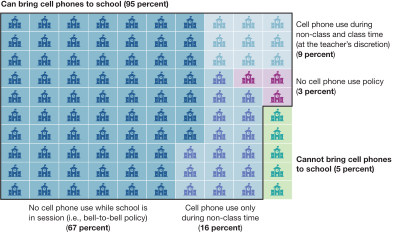
NOTE: This figure depicts response data from the following survey question administered to a nationally representative sample of K–12 school principals in October and November 2024: “What is your school’s cell phone policy this year (2024–25)?” (n = 955). We excluded responses from 3 percent of principals who said that they had “other” policies.
During the 2024–2025 school year, approximately four of five elementary and middle schools had a bell-to-bell policy, which stipulated that all cell phone use was prohibited during the entire school day (see Figure 2). High schools, however, tended to have more-lenient policies. About one-half of high schools allowed students to use their cell phones when class was not in session (e.g., during lunch or hallway transition time) but not during class time. One-quarter of high schools allowed students to sometimes use cell phones during class time at the teacher’s discretion.
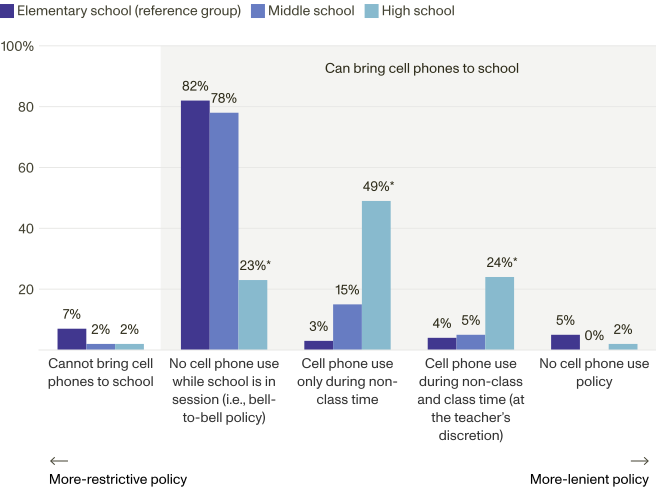
NOTE: This figure depicts response data from the following survey question administered to a nationally representative sample of K–12 school principals in October and November 2024: “What is your school’s cell phone policy this year (2024–25)?” (n = 927). We excluded responses from 3 percent of principals who said that their schools had “other” policies. An asterisk (*) indicates that the percentage of secondary (middle or high school) principals who reported that their school has a specific type of cell phone policy is statistically significantly different from the percentage of elementary principals who responded similarly.
We asked a separate nationally representative sample of K–12 school principals the following question in October 2024: “What are the school safety–related benefits or drawbacks of the student cell phone ban in place at your school?”[1] (In this survey, principals were not asked to provide more details about which specific restrictions the cell phone policy placed on students’ cell phone use, whether during class time or throughout the school day; therefore, the term ban is used loosely with respect to this survey.) As part of this question, we listed a variety of possible benefits and drawbacks that might be associated with such policies at their schools and asked principals which, if any, benefits and drawbacks applied to their schools (see Figure 3).
Principals overwhelmingly perceived their cell phone policies as a benefit to school safety. Eighty-six percent of principals said that their policy offered school safety–related benefits, including 59 percent who said that their policy resulted in only benefits to school safety and 26 percent who said that their policy resulted in a mix of benefits and drawbacks to school safety. The most-common benefits that principals reported were positive impacts on school climate (70 percent of principals), a reduction in inappropriate cell phone use (67 percent of principals), and a reduction in cyberbullying (54 percent of principals). Conversely, the most-common drawbacks that principals reported were concerns among parents (21 percent of principals) and students (10 percent of principals) about not having direct access to each other, including during an emergency.
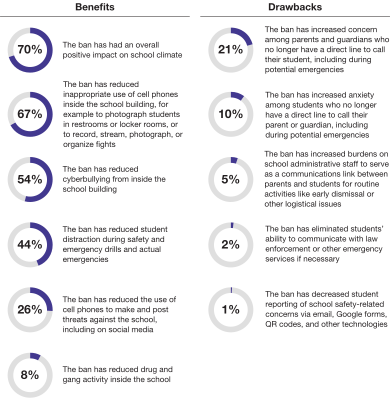
NOTE: This figure depicts response data from the following survey question administered to a nationally representative sample of K–12 school principals in October 2024: “What are the school safety–related benefits or drawbacks of the student cell phone ban in place at your school?” (n = 501). In their responses, principals were instructed to select all answers that applied. Only principals who reported having a cell phone ban in place for students at their school saw this question. The response option “The cell phone ban does not have an impact on school safety at my school” was selected by 13 percent of principals; this response option is not included in the figure.
Middle and high school principals were especially likely to identify benefits from cell phone use bans (see Figure 4). Relative to their elementary school counterparts, secondary school principals were more likely to cite positive impacts on school climate, a reduction in inappropriate cell phone use, and a decrease in cyberbullying. Middle school principals were also more likely to identify additional benefits, such as a reduction in the use of cell phones to make threats and lower levels of student distraction during safety drills or emergencies.
Even though middle school principals were particularly likely to report benefits, they were also the most likely to identify increased concern among parents about their lack of direct access to their children during an emergency. Conversely, high school principals reported the greatest levels of concern among students about increased anxiety from not being able to contact their parents.
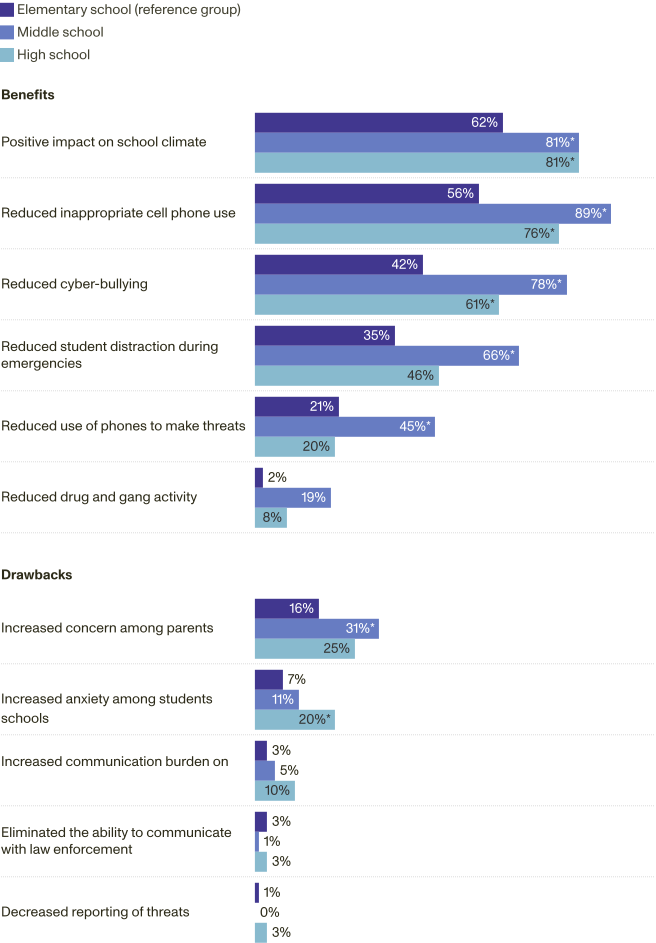
NOTE: This figure depicts response data from the following survey question administered to a nationally representative sample of K–12 school principals in October 2024: “What are the school safety–related benefits or drawbacks of the student cell phone ban in place at your school?” (n = 492). In their responses, principals were instructed to select all answers that applied. Only principals who reported having cell phone bans in place for students at their schools saw this question. The response option “The cell phone ban does not have an impact on school safety at my school” was selected by 19 percent of elementary school principals, 5 percent of middle school principals, and 5 percent of high school principals; this response option is not included in the figure. An asterisk (*) indicates that the percentage of middle or high school principals who selected a specific benefit or drawback is statistically significantly different from the percentage of elementary principals who responded similarly.
Emerging research suggests that youth are more skeptical of policies that put stronger restrictions on their cell phone use than their parents and educators (Aldis, 2024). To provide more insight on this point, in winter 2025, we asked a nationally representative sample of youth ages 12 to 21 who are members of the RAND American Youth Panel (AYP) how they felt about various cell phone use policies. Only AYP panel members who reported being enrolled in K–12 schools were asked about their schools’ cell phone policies. The vast majority of youth who received these questions were between the ages of 12 and 17, but a small portion of older youth were still enrolled in K–12 schools.
We found that, although youth were skeptical of blanket bell-to-bell policies prohibiting cell phone use during the entire school day, many youth did support at least some degree of cell phone use restriction. More specifically, 60 percent of youth enrolled in K–12 schools were supportive of some cell phone use restrictions during the school day (see Figure 5). Only 11 percent of youth said that cell phone use should be prohibited bell to bell. Although middle school grade youth and high school grade youth reported similar levels of comfort with some rules on cell phone use during the school day, younger youth were more supportive of more-restrictive practices. For example, the idea of storing cell phones in safe lockers was twice as popular among middle school grade youth than among high school grade youth. Conversely, high school grade youth were slightly more likely to report that phones should be prohibited in class only sometimes.
These results largely align with what principals reported as their schools’ policies; that is, restrictions on cell phone use in class are more common for younger students (see Figure 2).
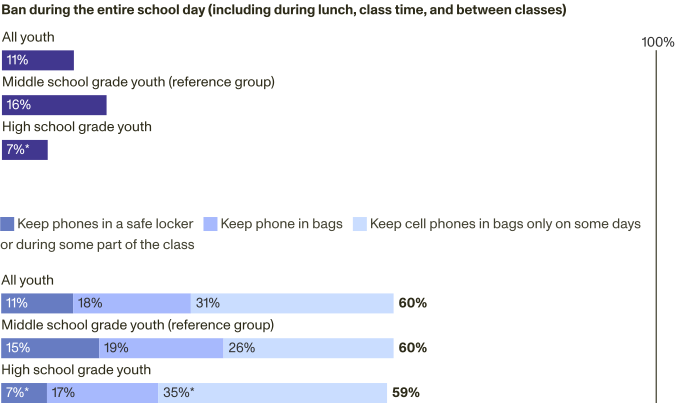
Ban during the entire school day (including during lunch, class time, and between classes)
Ban during classes in some form
NOTE: This figure depicts response data from the following survey questions administered to a nationally representative sample of youth ages 12 to 21 in January and February 2025: “Should [grade level] schools ban cell phones from the entire school day? This would include during lunch, class time, and between classes” and “Should [grade level] schools ban cell phones from classes?” (n = 1,270). Only youth who said that they were enrolled in K–12 public and private schools received this question. K–12 students who said that they were homeschooled only received this question if they took classes with students outside their family. The response options have been truncated for readability. An asterisk (*) indicates that the percentage of high school youth (i.e., those enrolled in grades 9 through 12) who supported a specific cell phone policy is statistically significantly different from the percentage of middle school youth (i.e., those enrolled in grades 5 through 8) who responded similarly.
We asked youth for their reason(s) for supporting or opposing policies prohibiting cell phone use during class. (We did not ask a similar question of youth who supported or opposed bell-to-bell policies prohibiting use for the entire school day.)
An overwhelming 88 percent of youth named reducing distractions as their reason for supporting policies that prohibit cell phone use during class time (see Figure 6). Reducing distractions beat out other reasons, such as reducing cheating, improving social skills, and reducing bullying. Relatively few youth identified reductions in cyberbullying as a reason to support such policies, even though more than one-half of principals identified this reason as a main benefit (see Figure 3).
There was also a clear top reason why youth reported that schools should not prohibit cell phone use in class: 81 percent of youth who were against such policies said that their parents should be able to reach them when needed. Adults who were surveyed also named this as their number one reason for opposing more-restrictive cell phone policies (Anderson, Gottfried, and Park, 2024).
The reasoning among youth for supporting or opposing cell phone policies that prohibit use during class time did not differ on the basis of age. That is, similar percentages of middle school grade youth and high school grade youth selected each reason for supporting or opposing such policies. There was one exception: High school grade youth were 10 percentage points more likely than their middle school grade counterparts to say that it is too hard to enforce a ban on cell phones.

NOTE: This figure depicts response data from the following survey questions administered to a nationally representative sample of youth ages 12 to 21 in January and February 2025: “Why should schools ban cell phones from classes?” and “Why shouldn’t schools ban cell phones from class?” (n = 1,199). Only youth who said that they were enrolled in K–12 public and private schools received this question. K–12 students who said that they were homeschooled only received this question if they took at least some in-person classes with students outside their family. Youth were asked only about their reasons for supporting (n = 756) or opposing cell phone bans (n = 443) during class on the basis of their indicated preference.
The debate over cell phone policies in schools reveals a complex balancing act between ensuring school safety and reducing distractions to keep students focused on learning. At the same time, schools must find ways to maintain communication between students and their families. The near ubiquity of cell phones in students’ lives and the growing role that technology plays in the classroom further complicate these issues.
The data we gathered from the survey panels suggest that principals largely view policies that restrict or prohibit students’ cell phone use as beneficial, citing reductions in cyberbullying and inappropriate phone use and benefits to school climate. Although many youth support some restrictions on cell phone use during class time, they generally remain skeptical of bell-to-bell policies that prohibit cell phone use during the entire school day. Students are especially concerned that such policies limit their ability to stay connected with their parents. There are indications that bell-to-bell policies also make parents nervous for the same reason and, in particular, that parents will not be able to reach their children in the event of an emergency (Chuck, 2024).
School leaders will need to grapple with these competing priorities and aim to strike the right balance as they craft cell phone policies that are age appropriate, enforceable, and responsive to the needs of both educators and students.
We are extremely grateful to the educators and youth who agreed to participate in the survey panels. Their time and willingness to share their experiences were invaluable to this effort and to helping us understand how to better support work in schools. We thank Daniel Ibarrola, Brian Kim, and Sarah Ohls for helping manage the surveys; Gerald Hunter, Ruolin Lu, and Julie Newell for serving as the data managers for these surveys; and Tim Colvin, Roberto Guevara, and Julie Newell for programming these surveys. Thanks to Joshua Eagan, Dorothy Seaman, and Claude Messan Setodji for managing the sampling and weighting. We greatly appreciate the administrative support provided by Tina Petrossian. We also appreciate feedback from Julia Kaufman, who reviewed early drafts of this report. We thank Elizabeth Steiner and Brigette Whaley for helpful feedback that greatly improved this report. We also thank Valerie Bilgri for her editorial expertise and Monette Velasco for overseeing the publication process.
This report is based on research funded by the Gates Foundation and undertaken by RAND Education and Labor.
This publication is part of the RAND research report series. Research reports present research findings and objective analysis that address the challenges facing the public and private sectors. All RAND research reports undergo rigorous peer review to ensure high standards for research quality and objectivity.
This work is licensed under a Creative Commons Attribution 4.0 International License. All users of the publication are permitted to copy and redistribute the material in any medium or format and transform and build upon the material, including for any purpose (including commercial) without further permission or fees being required.
RAND is a nonprofit institution that helps improve policy and decisionmaking through research and analysis. RAND's publications do not necessarily reflect the opinions of its research clients and sponsors.

