
Health Care Access and Quality for New York Veterans
Implications of Expanding Community Care Eligibility
Research SummaryPublished Apr 29, 2026
Implications of Expanding Community Care Eligibility
Research SummaryPublished Apr 29, 2026

Photo by Northwell Health
Approximately 315,000 veterans in New York — about half of New York's total veteran population — are enrolled in U.S. Department of Veterans Affairs (VA) health benefits. In New York, VA provides health care directly to veterans at its 12 VA medical centers and 50 outpatient clinics. It also provides care through 570,000 private-sector health care providers through the VA Community Care program.
Eligibility for Community Care is currently limited to veterans who meet specific criteria, such as those with long drive times or wait times for VA care. Proposed policy changes to the Community Care program might reduce or remove these eligibility requirements. Expanding eligibility for Community Care could substantially increase the number of veterans using it.
To better understand how expanding eligibility for Community Care could affect access to and the quality of health care for New York veterans, RAND researchers used publicly available data to assess the current state of VA care and Community Care. Specifically, the research team examined the drive times to health care facilities (geographic access), time to obtain an appointment (timeliness), and quality of care delivered.
For primary care and mental health care, veterans enrolled in VA health care benefits are eligible for Community Care if their average drive time to a VA facility offering these services exceeds 30 minutes. For specialty care, veterans are eligible for Community Care if their average drive time to a VA facility exceeds 60 minutes.
Geographic access to VA health care is limited in New York. Of the 62 counties in New York, 42 (67.7 percent) have a VA facility (VA medical center or outpatient clinic). An estimated 47 percent of New York veterans — less than half — live within a 30-minute drive of a VA health care facility, compared with approximately 87 percent who live within a 60-minute drive.
The Community Care Network (CCN) expands geographic access to veterans in many, but not all, areas. VA CCN providers are distributed across many parts of the state but are clustered in urban population centers, such as New York City, Syracuse, and Buffalo. VA medical centers are also often located in these areas. Rural counties in northern New York, such as Hamilton, Warren, and Essex counties, are the least served by both VA and CCN providers.
About one-fifth of New York veterans lack geographic access within 30 minutes of a VA mental health or CCN behavioral health care provider. Eligibility for behavioral health care from CCN providers based on drive times to VA facilities (more than 30 minutes for primary care and mental health care) varies substantially across New York (Figure 1, Panel A). An estimated 54 percent of New York veterans live more than 30 minutes from a VA facility with mental health care services. The CCN substantially expands geographic access (Figure 1, Panel B), but 19 percent of New York veterans still live more than 30 minutes from either a VA facility providing mental health care or a CCN behavioral health provider.

Map of New York State showing many purple shaded service or coverage areas spread across most regions, including western, central, eastern, and downstate areas. Yellow dots and red cross-shaped markers identify specific locations, with the heaviest concentration appearing in the New York City and Long Island region.

Map of New York State shaded mostly orange, with many green dots marking locations across the state and several red cross-shaped markers highlighting select sites. Green points are most densely clustered in New York City and Long Island, with additional concentrations in western and central New York.
SOURCE: Features information from VA.
NOTE: Panel A: Drive-time service areas (shown in purple) represent the geographic areas reachable by driving 30 minutes from a VA medical center (shown as red crosses) or a VA outpatient clinic (shown as yellow dots). Panel B: Drive-time service areas (shown in orange) are reachable within 30 minutes of a VA medical center (shown as red crosses), a VA outpatient clinic (shown as yellow dots), or a VA CCN behavioral health provider (shown as green dots).
For primary care and mental health care, veterans are eligible for a referral to Community Care if the wait time for an appointment is longer than 20 days. For specialty care, veterans are eligible if the wait time for an appointment exceeds 28 days. While VA releases wait-time data by specialty and facility daily, similar data are not available from CCN providers.
Wait times are much shorter for established patients than for new patients. Average wait times for VA care in New York vary substantially by type of care, ranging from 0 to 15 days for established patients and 12 to 78 days for new patients (Figure 2).
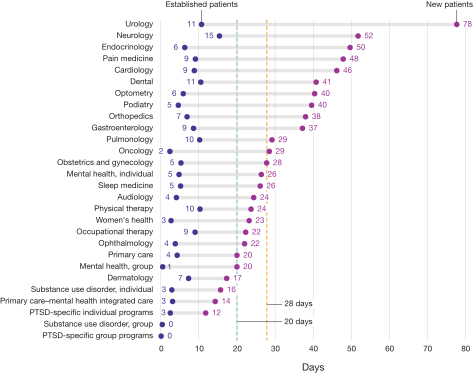
| Established patients | New patients | |
|---|---|---|
| Urology | 11 days | 78 days |
| Neurology | 15 days | 52 days |
| Endocrinology | 6 days | 50 days |
| Pain medicine | 9 days | 48 days |
| Cardiology | 9 days | 46 days |
| Dental | 11 days | 41 days |
| Optometry | 6 days | 40 days |
| Podiatry | 5 days | 40 days |
| Orthopedics | 7 days | 38 days |
| Gastroenterology | 9 days | 37 days |
| Pulmonology | 10 days | 29 days |
| Oncology | 2 days | 29 days |
| Obstetrics and gynecology | 5 days | 28 days |
| Mental health, individual | 5 days | 26 days |
| Sleep medicine | 5 days | 26 days |
| Audiology | 4 days | 24 days |
| Physical therapy | 10 days | 24 days |
| Women's health | 3 days | 23 days |
| Occupational therapy | 9 days | 22 days |
| Ophthalmology | 4 days | 22 days |
| Primary care | 4 days | 20 days |
| Mental health, group | 1 days | 20 days |
| Dermatology | 7 days | 17 days |
| Substance use disorder, individual | 3 days | 16 days |
| Primary care-mental health integrated care | 3 days | 14 days |
| PTSD-specific individual programs | 3 days | 12 days |
| Substance use disorder, group | 0 days | 0 days |
| PTSD-specific group programs | 0 days | 0 days |
SOURCE: Features data from VA Access to Care dataset as of October 2, 2025.
NOTE: Average wait times are calculated based on all New York VA facilities with available data for each service type. Averages are not weighted by facility size. All values are rounded to the nearest integer. Not all facilities report data for all service types. Vertical indicators highlight the 20-day (primary care and mental health care) and 28-day (specialty care) Community Care eligibility wait-time standards. PTSD = posttraumatic stress disorder.
Most New York VA facilities meet VA wait-time standards for established patients, but many VA facilities exceed wait-time standards for new patients. The average wait time for a VA primary care appointment in New York is 4.3 days for established patients and 20.0 days for new patients. One New York VA facility exceeds the 20-day wait-time threshold for established primary care patients, whereas 17 facilities exceed it for new patients.
Average wait times for mental health care in New York VA facilities are 4.8 days for established patients but are much longer (26.4 days) than VA standards for new patients. No New York facility exceeds VA's 20-day wait-time standard for established mental health patients, but 14 facilities exceed this wait time for new patients.
Recent comparison data on appointment wait times for Community Care providers in New York are not available, but data from 2018 through 2021 indicate that wait times were the same or shorter in New York VA facilities. A 2022 study in JAMA Network Open reported that appointment wait times for new patients in Veterans Integrated Service Network region 2 (which includes most of New York) were lower in VA compared with Community Care for primary care and specialty care and were similar for mental health care.
VA regularly measures and releases data on the quality of care provided in VA facilities. VA compares quality performance with regional or national private-sector facility benchmarks, which may or may not be representative of care quality provided in Community Care. Quality measure data specific to CCN providers are not available.
National studies have concluded that VA often, but not always, provides care that is of similar or better quality than Community Care. Although not specific to New York, 23 studies using data from 2014 or later generally found VA care to be of similar or better quality than Community Care, particularly with respect to the safety, effectiveness, and timeliness of care.
New York VA facilities generally perform as well as or better than regional providers in many domains, although performance is not uniformly superior across all measures. New York VA facilities generally outperform national and regional private-sector comparators on outpatient care effectiveness, patient experience, some aspects of mortality and readmission, and emergency department timeliness. New York VA facilities have mixed performance compared with private-sector providers in the same regions on inpatient quality, hospital-acquired infections, and patient safety metrics. There is substantial variation across New York VA facilities, with no clear trends.
Overall, policy proposals to expand eligibility for Community Care have unclear implications for veterans in New York. Expanding eligibility for Community Care will likely increase demand for it, although expansion has unclear implications for demand for VA care. Veterans deserve geographically accessible, timely, and high-quality health care. However, whether expanding eligibility for Community Care will achieve these goals depends on its implementation and how the CCN evolves.
Evaluation of the consequences of proposed policy changes to Community Care is constrained by limited data availability and the quality of available data sources. To estimate how changes to the Community Care program will affect veterans, more-complex analyses, possibly using a simulation model, are necessary. To build a simulation model, more and better data are required. VA could enable such analyses by making data on CCN providers, wait times, utilization, and expenditures publicly available.

This publication is part of the RAND research brief series. Research briefs present policy-oriented summaries of individual published, peer-reviewed documents or of a body of published work.
This document and trademark(s) contained herein are protected by law. This representation of RAND intellectual property is provided for noncommercial use only. Unauthorized posting of this publication online is prohibited; linking directly to this product page is encouraged. Permission is required from RAND to reproduce, or reuse in another form, any of its research documents for commercial purposes. For information on reprint and reuse permissions, please visit www.rand.org/pubs/permissions.
RAND is a nonprofit institution that helps improve policy and decisionmaking through research and analysis. RAND's publications do not necessarily reflect the opinions of its research clients and sponsors.


