
Efforts to Lower Health Care Costs Through Informed Consumer Choice
A Synthesis of Findings from Minnesota
Research SummaryPublished May 4, 2026
A Synthesis of Findings from Minnesota
Research SummaryPublished May 4, 2026

Photo by FatCamera/Getty Images
In an effort to control health care costs, the State of Minnesota has been using a tiered cost-sharing health insurance approach — the State Employee Group Insurance Program's (SEGIP) Minnesota Advantage Health Plan — to cover its 130,000 employees and dependents since 2002. SEGIP's benefit design, which assesses primary care clinics (PCCs) for total cost of care (TCOC) and is administered by two health plans, aims to incentivize PCCs to become more efficient and shares savings with consumers who choose PCCs with lower TCOCs.
This brief synthesizes the findings from multiple articles that have examined various aspects of SEGIP's design and outcomes. It could be useful to other large employers considering similar approaches to lowering health care–plan costs.
PCCs serve as central care managers within the SEGIP design, providing primary care to patients. PCCs are also responsible for referrals for specialists, hospitals, and pharmaceuticals and for managing patients' TCOC.
PCCs are placed into one of four cost-sharing tiers based on their annual risk-adjusted per-capita TCOC over the previous two years; assignment to a tier is based on TCOC performance relative to other clinics in the state. SEGIP's design to incentivize cost-cutting is focused on several mechanisms. PCCs can lower patients' TCOC — and thus improve their tier assignment — through such actions as lowering prices, reducing the use of avoidable or low-value health care services, and managing referrals to lower-cost specialists, hospitals, and pharmacies. Following their initial tier assignment, PCCs may annually negotiate a different tier placement if they agree to lower their prices.
Each year during open enrollment, SEGIP members make two sequential selections. First, they select one of the two administering health plans, and then they designate PCCs for themselves and their dependents for the coming calendar year. Members may choose different PCCs for each dependent, but all must enroll in the same health plan.
Although both plans administer the same benefit design, PCCs may be placed in different tiers across plans for two reasons. First, to ensure that every member has access to at least a Tier 2 clinic within 30 miles of their workplace, SEGIP may administratively reassign a clinic from a higher tier (Tier 3 or 4) to Tier 2 in one plan. Second, a clinic may negotiate a lower fee schedule with only one plan, resulting in a lower tier placement in that plan. Consequently, PCCs may not occupy the same tier in both plans. Information on PCC tiers and costs for both health plans is available via a public website in advance of members making these selections, so they can choose their preferred plan-clinic combination. Premiums for each tier are the same across the different health plans, although the tiers themselves vary by deductible, copayments, and the patient's maximum annual out-of-pocket cost. Patients choosing PCCs in higher tiers (i.e., those with higher risk-adjusted total costs) face higher cost-sharing.
The differences in cost-sharing across the tiers are substantial. For example, for family coverage in 2020, deductibles ranged from $300 in Tier 1 to $2,500 in Tier 4. Office visit copayments ranged from $30 in Tier 1 to $85 in Tier 4, and maximum annual out-of-pocket spending limits ranged from $2,400 to $5,200, excluding prescription drugs.
The design of SEGIP is based on several principles. First is the expectation that having one entity (the PCC) manage care increases efficiency (i.e., lowers costs) in health care provision overall. A second expectation is that SEGIP patients will choose lower-tier PCCs to increase their cost-sharing savings. A third expectation is that any PCC loss of revenue from lower prices and the provision of fewer avoidable or lower-value health care services can be offset by an increase in the number of SEGIP members choosing that PCC.

Photo by Hispanolistic/Getty Images
Researchers at RAND, the University of Minnesota, and Brown University have conducted multiple analyses of different aspects of SEGIP's implementation and outcomes, using primary data analysis, modeling, and key-informant interviews and surveys. Findings from these analyses are synthesized in the following section.
PCCs report being motivated to avoid placement in higher tiers for reasons that include
PCCs actively respond to being placed in higher cost-sharing tiers by taking steps to lower their costs and improve their tier placement. For example, researchers found that
In interviews, clinic leaders reported interest in methods to lower total costs beyond reducing prices — for example, by reducing low value care. Although SEGIP patients are generally a small percentage of a clinic's total patient population (ranging from 2.2 percent to 6.1 percent), some clinics expressed concern that discounted prices for SEGIP members could lead to economic losses and questioned whether such discounts would be sustainable if SEGIP patients made up a larger portion of their total patient base.
When selecting PCCs, SEGIP members show a strong preference for clinics in the lowest cost-sharing tiers. For example, researchers found that
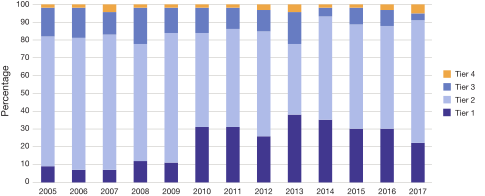
See the bullet points above the figure for a description of the data.
SOURCE: Adapted from Tim McDonald, Katie M. White, Tsan-Yao Huang, Christopher M. Whaley, and Bryan Dowd, "Clinic Price Reductions in a Tiered Total Cost Benefit Design," American Journal of Managed Care, Vol. 27, No. 9, September 2021.
Although SEGIP members demonstrate cost sensitivity in their initial PCC selection, most stick with the same clinic in the following years, even if the clinic moves to a higher (i.e., more expensive) tier. Researchers found that
A randomized controlled trial in 2019 sought to understand whether providing additional information about tier levels via email would lead more members to choose clinics in lower tiers (i.e., reduce inertia). At the time, members could use SEGIP's PCC directory website to look up tier information for every PCC in the state, although PCCs were not grouped by location and information about each PCC's tier in each of the two health plans was found on a separate webpage.
During open enrollment for the 2020 calendar year (which ran from October 30th to November 20th, 2019), members in the treatment group received an email reminding them to check whether their current PCC would be changing tiers, reiterating the cost differences between tiers, and highlighting the tiers and tier changes for PCCs in their geographic area. However, the email had only a small effect on members in the treatment group changing their PCC or health plan choice. Researchers found the following:

Photo by Drazen Zigic/Getty Images
Interviews with clinic leaders (including those responsible for both clinical practice and operations) have identified the six barriers to program implementation and potential efficiency gains.
Clinic leaders indicated that they do not have accessible or sufficient data on the drivers of TCOC for their SEGIP patient population, including the relative costs and resource use of specialty referrals, hospital care, and pharmaceuticals and information about which costs are driven by prices versus volume. In addition, interviewees reported wanting better data and more transparency about how their cost-sharing tier is determined and what drives their TCOC.
Within SEGIP, costs associated with referrals for specialists, hospitals, and pharmaceuticals (i.e., nonprimary care costs) account for 40 percent to 85 percent of TCOC. Clinic leaders reported multiple challenges to making more-efficient referrals, including limited referral options, especially in rural areas. Leaders from clinics that are part of a health system or have referral relationships with health systems reported experiencing pressure to refer within their own system regardless of costs, citing nonfinancial benefits, such as shared electronic medical records and the potential for lost information or poor coordination related to referrals to out-of-network specialists and hospitals. In addition, interviewees pointed out that when patients travel and incur costs in other states, those costs are difficult or impossible to control.
Clinic leaders reported that patient preference for specialists or hospitals might influence referrals, although this can create a potential conflict between accommodating patient preference and being cost effective. For some patients, preferences are related to care at specialist clinics — for example, for treatment of chronic conditions — with patients prioritizing continuity of care. Some interviewees mentioned that patients sometimes self-refer, making unauthorized visits to specialists and hospitals, and later request a retroactive referral.
Clinic leaders reported resource constraints, such as limited personnel to oversee changes to care processes (e.g., use of data to improve patient care) and limited bandwidth because of the complexity of national payment programs and the implementation of such new technologies as electronic medical records. Such constraints were especially a concern for small, independent clinics. Some interviewees pointed to a lack of funding to support improvements.
Interviewees also indicated that the limited size of the SEGIP patient population as a percentage of their clinic's total patient population (2.2 percent to 6.1 percent among interviewed PCCs) is not large enough on its own to motivate major changes to their practices. Clinic leaders reported being unsure whether they would gain or lose enough patients to justify making investments in their care and administrative processes. As noted previously, many PCCs chose to reduce prices for SEGIP consumers; however, multiple clinic leaders stated that the expansion of such discounted prices to a larger portion of their patient base would be unsustainable
Because of SEGIP's resource constraints, it has meaningful but limited interactions with PCCs, relying on the two selected health plans to administer the program. This can lead to questions about SEGIP processes, such as tiering. For example, some clinic leaders appeared to be unaware that a clinic's tier placement is relative to the performance of other clinics in the state. Some interviewees reported that they think SEGIP would have more leverage than individual clinics to negotiate prices with specialists.
Under SEGIP tiering, incentives for PCCs (e.g., a gain or loss in consumer volume) accrue to the clinic; however, there is no direct incentive for primary care providers. Physicians reported that they do not differentiate care unless they know that there might be large out-of-pocket costs to the patient that are appropriate to avoid. Physicians also reported a desire to refer their patients based on the level of care that they felt their patients would receive rather than based on cost.

Photo by Drazen Zigic/Getty Images
As health care costs increase annually, health benefit providers seek program designs that will deliver better health outcomes for less cost. SEGIP's approach to meeting this objective focuses on incentivizing PCCs to control overall care costs and incentivizing program members to select PCCs that are successful in controlling such costs. The research finds patients and clinics respond to the incentives created by the SEGIP tiered TCOC design, but more research is needed to understand the effects on overall program savings and effectiveness. Among some clinic leaders, there is praise for what they view as the strong alignment of the SEGIP design with value for care. Others find that the system is aligned with value in concept but barriers limit their PCC's ability to perform in the way the system intends. Providing clinics with better information on how tiers are determined; the costs of specialists, hospitals, and pharmaceutical providers; and how to use data to make lower-cost referrals could support PCCs' efforts to increase their efficiency.
This publication is part of the RAND research brief series. Research briefs present policy-oriented summaries of individual published, peer-reviewed documents or of a body of published work.
This document and trademark(s) contained herein are protected by law. This representation of RAND intellectual property is provided for noncommercial use only. Unauthorized posting of this publication online is prohibited; linking directly to this product page is encouraged. Permission is required from RAND to reproduce, or reuse in another form, any of its research documents for commercial purposes. For information on reprint and reuse permissions, please visit www.rand.org/pubs/permissions.
RAND is a nonprofit institution that helps improve policy and decisionmaking through research and analysis. RAND's publications do not necessarily reflect the opinions of its research clients and sponsors.