
How Much More Power Can the U.S. Grid Provide for AI?
Projections and Policy Implications for 2030
Research SummaryPublished Apr 29, 2026
Projections and Policy Implications for 2030
Research SummaryPublished Apr 29, 2026
The anticipated growth in electricity demand from artificial intelligence (AI) is large, rapid, and geographically concentrated. Because of uncertainty about which planned generation projects will be completed, it is difficult to assess whether future U.S. grid capacity will keep pace with demand from AI data centers. An additional challenge lies in translating announced nameplate capacity into comparable estimates of reliable power that can meet large, inflexible loads to support data center power needs.[1] These factors complicate efforts to estimate how much additional power capacity the United States is likely to have by 2030.
A team of RAND researchers estimated how much additional power capacity the United States is likely to have by 2030 by translating planned electricity supply resources into a common measure of reliable capacity. For front-of-the-meter (FTM) resources,[2] the researchers analyzed planned generation and storage projects based on independent system operator (ISO) interconnection queues and federal generation data and applied historical completion rates by region and technology.[3] This process adjusted for resource contributions to reliability and accounted for planned retirements to estimate net additions to grid capacity.
For behind-the-meter (BTM) resources,[4] such as customer-sited solar and battery storage, the researchers relied on national deployment projections through 2030 and converted projected nameplate capacity into effective capacity using the same framework as in FTM.[5] Using this approach, the researchers estimated how much BTM resources could reduce peak grid demand and free up capacity for large loads, such as AI data centers.
The researchers found that the United States could add approximately 82 gigawatts (GW) of net available capacity by 2030,[6] consisting of 33 GW from FTM resources and 49 GW from BTM resources; see Table 1.
| Region | FTM | BTM | Combined |
|---|---|---|---|
| CAISO | (1.2) | 3.6 | 1.9 |
| ERCOT | 59.0 | 10.0 | 69.0 |
| NE-ISO | 3.3 | 1.0 | 4.3 |
| MISO | (12.0) | 11.0 | (0.8) |
| NY-ISO | 0.4 | 3.3 | 3.6 |
| PJM | (5.3) | 4.7 | (0.7) |
| SPP | (1.7) | 3.5 | 1.8 |
| All other regions | (9.4) | 12.0 | 2.7 |
| Total | 33.0 | 49.0 | 82.0 |
NOTE: CAISO = California Independent System Operator; ERCOT = Electric Reliability Council of Texas; MISO = Midcontinent Independent System Operator; NE-ISO = New England Independent System Operator; NY-ISO = New York Independent System Operator; SPP = Southwest Power Pool. Negative FTM values (shown in parentheses) indicate that the expected additions to available capacity are less than the reductions in available capacity from expected retirements. Numbers might not add up to totals because of rounding.
Figure 1 illustrates how planned FTM generation and storage projects are translated from 1,086 GW of nameplate capacity into the estimated 33 GW of net available capacity after project attrition, retirements of existing plants, and differences in resource contributions to reliability are accounted for.
Projects in interconnection queue and forecasted additions
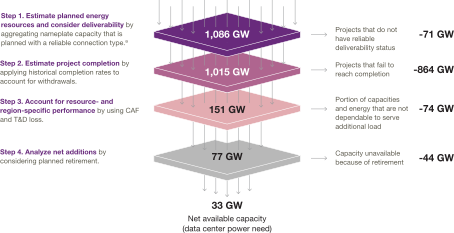
Interconnection queue funnel: 1,086 GW shrinks to 33 GW net available capacity after losses.
Step 1. Estimate planned energy resources and consider deliverability by aggregating nameplate capacity that is planned with a reliable connection type. Net available capacity (data center power need) = 1,086 gigawatts. Projects that do not have reliable deliverability status = -71 gigawatts.
Step 2. Estimate project completion by applying historical completion rates to account for withdrawals. Net available capacity (data center power need) = 1,015 GW gigawatts. Projects that fail to reach completion = -864 gigawatts.
Step 3. Account for resource- and region-specific performance by using CAF and T&D loss. Net available capacity (data center power need) = 151 gigawatts. Portion of capacities and energy that are not dependable to serve additional load = -74 gigawatts.
Step 4. Analyze net additions by considering planned retirement. Net available capacity (data center power need) = 77 gigawatts. Capacity unavailable because of retirement = -44 gigawatts.
NOTE: CAF = capacity accreditation factor; T&D = transmission and distribution. Values in gigawatts might not sum precisely because of rounding.
a The analysis includes only projects with interconnection types that ensure a reliable power supply to data centers, overcoming transmission line constraints, available grid capacity, and potential congestion. Further details are available in the accompanying research report.
Net FTM capacity additions vary substantially by region, reflecting differences in generation mixes, the composition of interconnection queues, and retirement schedules. Growth in ERCOT interconnection requests drives a large share of forecasted additions (see Table 2), while queue requests are paused in CAISO and PJM.[7] Figure 2 provides a consolidated view of how different resource types contribute to the gap between planned nameplate capacity additions and net available capacity.
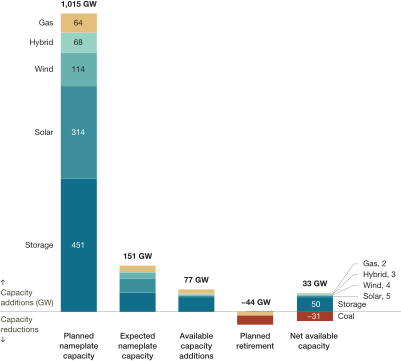
| Resource | Planned Nameplate Capacity | Expected Nameplate Capacity | Available Capacity Additions | Planned Retirement | Net Available Capacity |
|---|---|---|---|---|---|
| Coal | 0 | 0 | 0 | -31 | -31 |
| Gas | 64 | 19 | 14 | -12 | 2 |
| Other | 0 | 0 | 0 | 0 | 0 |
| Nuclear | 0 | 0 | 0 | 0 | 0 |
| Biomass | 0 | 0 | 0 | 0 | 0 |
| Solar | 314 | 42 | 5 | 0 | 5 |
| Wind | 114 | 19 | 4 | 0 | 4 |
| Geothermal | 0 | 0 | 0 | 0 | 0 |
| Hydro | 2 | 1 | 0 | 0 | 0 |
| Hybrid | 68 | 5 | 3 | 0 | 3 |
| Storage | 451 | 65 | 50 | 0 | 50 |
| Total | 1015 GW | 151 GW | 77 GW | -44 GW | 33 GW |
SOURCES: Planned nameplate capacity is estimated from October 2024 interconnection queues for CAISO, NY-ISO, ERCOT, NE-ISO, SPP, and MISO, and non-ISO planned capacity is as reported in U.S. Energy Information Administration, 2025. Expected nameplate capacity applies historical completion rates to planned capacity, as estimated from CAISO, NY-ISO, SPP, and MISO interconnection queues and self-reported by ERCOT. Non-ISO and NE-ISO completion rates are estimated as averages of completion rates across other regions. Available capacity, then, also takes transmission line losses and effective load-carrying capability (ELCC) estimates for CAISO, NY-ISO, ERCOT, NE-ISO, SPP, and MISO into account, using an average for non-ISO resources. Planned retirement resources are estimated by applying ELCC and transmission loss factors to nameplate capacity of resources scheduled for retirement in 2025–2030 that appear in U.S. Energy Information Administration, 2025. Net available capacity for 2025–2030 is equal to available capacity additions minus planned retirements.
BTM resources play an important role in reducing peak grid demand and potentially freeing up FTM capacity. Projected BTM additions total 49 GW by 2030 (Table 3), though the contribution varies by region. In some regions, accounting for BTM resources materially changes the aggregate capacity outlook, while in others the effect is modest.
| Actual | Forecast | ||||||
|---|---|---|---|---|---|---|---|
| 2024 | 2025 | 2026 | 2027 | 2028 | 2029 | 2030 | |
| ISO regions | |||||||
| CAISO | 3.0 | 3.1 | 3.2 | 3.3 | 3.4 | 3.5 | 3.6 |
| ERCOT | 2.0 | 3.3 | 4.7 | 4.8 | 4.9 | 6.9 | 9.0 |
| NE-ISO | 0.2 | 0.2 | 0.2 | 0.4 | 0.6 | 0.8 | 1.0 |
| MISO | 2.2 | 2.5 | 2.9 | 3.9 | 5.0 | 8.1 | 11.2 |
| NY-ISO | 0.8 | 1.6 | 2.3 | 2.6 | 2.8 | 3.0 | 3.3 |
| PJM | 0.9 | 1.8 | 2.6 | 2.9 | 3.2 | 3.9 | 4.7 |
| SPP | 0.5 | 0.6 | 0.7 | 0.9 | 1.1 | 2.3 | 3.5 |
| Non-ISO regions | 2.3 | 3.5 | 4.6 | 6.0 | 7.3 | 9.7 | 12.0 |
| Annual incremental | — | 4.7 | 4.7 | 3.5 | 3.5 | 10.0 | 10.0 |
| Total | 12.0 | 17.0 | 21.0 | 25.0 | 29.0 | 39.0 | 49.0 |
Note: Numbers might not add up to totals because of rounding.
The study had some important limitations and assumptions. The researchers assumed that data center load profiles are firm and inflexible. They also assumed static estimates of resource contributions to reliability. For BTM resources, the researchers based their estimates on aggregate projections rather than public project announcements. They also assumed that BTM resources will continue to be built out and that retirements will be limited.
The study's findings suggest that planned power capacity expansions are unlikely to align evenly with the geographic distribution and timing of rapidly growing electricity demand, particularly from large, inflexible loads, such as AI data centers. Policymakers and planners may therefore need to focus explicitly on locational adequacy, especially in regions where net additions of reliable capacity are limited. Incorporating realistic project completion rates, retirements, and resource reliability is critical for assessing future grid adequacy.
The analysis also highlights the importance of managing uncertainty through diversified resource portfolios. Although BTM resources can meaningfully reduce peak demand in some regions, they are unlikely to fully offset shortfalls in grid-connected supply where constraints are most severe.
Further research could refine these estimates by incorporating transmission expansion scenarios, more-granular locational data, and alternative demand growth trajectories from uncertain large-load growth.

This publication is part of the RAND research brief series. Research briefs present policy-oriented summaries of individual published, peer-reviewed documents or of a body of published work.
This document and trademark(s) contained herein are protected by law. This representation of RAND intellectual property is provided for noncommercial use only. Unauthorized posting of this publication online is prohibited; linking directly to this product page is encouraged. Permission is required from RAND to reproduce, or reuse in another form, any of its research documents for commercial purposes. For information on reprint and reuse permissions, please visit www.rand.org/pubs/permissions.
RAND is a nonprofit institution that helps improve policy and decisionmaking through research and analysis. RAND's publications do not necessarily reflect the opinions of its research clients and sponsors.
