
The Limited Presence of Male Mentors in the Lives of Boys and Young Men
ResearchPublished Nov 18, 2025

Photo by pixdeluxe/Getty Images
Boys and young men face a series of challenges as they navigate the transition from adolescence to adulthood, and new survey data, collected by us and others, suggest that these challenges span several critical developmental domains. For example, compared with girls, boys today earn lower grades in school, have lower literacy rates, are more likely to be suspended, are more likely to drop out of high school, are less likely to enroll in college, and are less likely to earn a college degree (Reeves, 2022). In young adulthood, men are more likely than women to be disconnected—that is, not participating in education, employment, or job training (Wenger and Bonds, 2025). Moreover, young men are more likely than young women to be single (Juteau, 2023) and to live at home with their parents (Loo, 2024). Of particular concern is how these developmental challenges might be contributing to the rise in male suicide. Men are four times more likely than women to die by suicide; rates of suicide increased by 26 percent between 2010 and 2023 among men between the ages of 15 and 24 (Reeves and Secker, 2023).
One approach that might help address these challenges is more active involvement of male mentors. These mentors can serve as guides to the younger generation as they seek advice and support for their schooling, their relationships, and their plans for the future. Mentoring can occur as part of a formal mentoring program or informally through social networks. Informal mentoring is far more common than formal mentoring, especially among young people from higher-income households (Garringer and Benning, 2023). Male mentors can provide positive role models in terms of how to carry oneself, and they can offer boys and young men empathy grounded in shared experience.
For boys and young men living in traditional two-parent families, the most readily accessible mentor is typically their father. A deep body of social science research demonstrates that paternal presence and involvement are associated with positive educational and behavioral outcomes (Sarkadi et al., 2008). There is some evidence that these observed positive outcomes are more pronounced for sons than for daughters, underscoring the importance of a father for the development of boys and young men in particular (Emmot and Mace, 2021). In the absence of a father, a male mentor (whether a family member or someone else) can still help make a difference: Engaged mentors improve educational and behavioral outcomes for their mentees.
There is also suggestive evidence that boys receive a greater benefit than girls do from same-sex mentors (Kraft, Bolves, and Hurd, 2023; Raposa et al., 2019). Although finding sufficient numbers of male volunteers to serve as mentors is a known challenge even in long-established mentoring programs, male mentors and mentees have reported stronger, longer-lasting relationships than female mentor-mentee pairs (Tierney, Grossman, and Resch, 1995; Foster-Bey, Dietz, and Grimm, 2006; Spencer et al., 2018).
In this brief report, we document new data on the prevalence of male mentors in the lives of contemporary boys and young men. We find that, although most boys have mentors, those mentors are often women—especially in such communities as schools and low-income families, in which adult women outnumber adult men. We hope these findings can be useful to policymakers and program developers focused on solutions to support the well-being of boys and young men as they navigate the transition from adolescence to adulthood. This report is based on data from a survey we fielded to a nationally representative sample of 1,083 males between the ages of 12 and 21 from the RAND American Life Panel and the Ipsos KnowledgePanel. Members of these panels are drawn using probability sampling methods, and the data are weighted to reflect the demographic diversity of the U.S. youth population. We fielded the survey in May 2025. All data presented in the figures can be found in Appendix A, including standard errors, confidence intervals, and sample sizes. The wording of the key survey questions used in this report is provided in Appendix B.
Most Boys and Young Men Have a Mentor in Their Lives as a Guide for Schoolwork, Relationships, and Future Plans, but This Mentor Is Most Often Female
In the survey, we asked our sample of boys and young men to report whether there is an adult they can turn to for help in three life domains: schoolwork, relationships (including friendships), and planning for the future. Sample members were given four options, reported separately for each life domain: (1) Yes, I can turn to my mom; (2) Yes, I can turn to my dad; (3) Yes, I can turn to an adult who is not my parent; or (4) No. For the first three options, sample members were instructed to select all that apply. If they responded that they turn to an adult who is not their parent, they received a follow-up question that asked whether that person is a man or a woman. Using the responses to these questions, we determined whether the sample member had any mentor, whether they had a female mentor, and whether they had a male mentor.
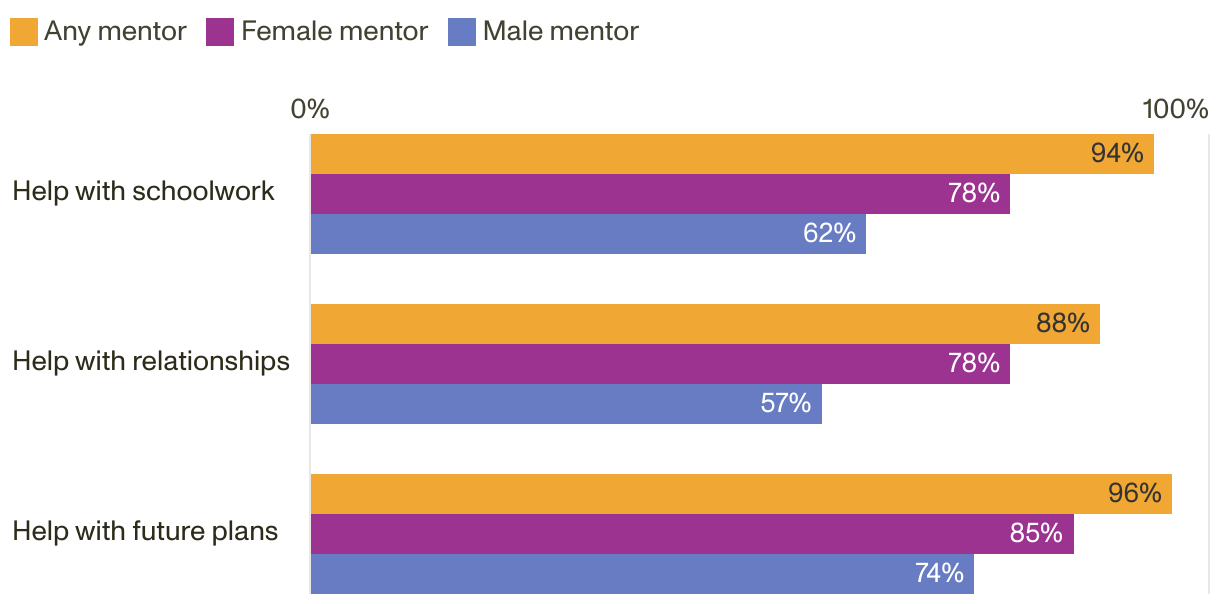
Figure 1 shows that nearly all boys and young men in our sample had an adult whom they could turn to for help with schoolwork, relationships, and future plans. However, this mentor is much more likely to be a woman than a man. For example, 78 percent of boys and young men in our sample reported having a female mentor for schoolwork, compared with only 62 percent who reported having a male mentor, which likely reflects a female-dominated teacher workforce.
Figure 1. Percentage of Boys and Young Men (Ages 12–21) Who Reported Having a Mentor
- Help with schoolwork
- Any mentor: 94%
- Female mentor: 78%
- Male mentor: 62%
- Help with relationships
- Any mentor: 88%
- Female mentor: 78%
- Male mentor: 57%
- Help with future plans
- Any mentor: 96%
- Female mentor: 85%
- Male mentor: 74%
SOURCE: Authors’ analysis of RAND American Life Panel and Ipsos KnowledgePanel survey data, May 2025; n = 1,083.
One in Three Boys and Young Men Does Not Have an Adult Male He Can Turn to for Help with His Schoolwork and Relationships
Although access to mentors is relatively common, boys and young men have fewer adult men to whom they can turn: 38 percent do not have an adult male they can turn to for help with schoolwork, and 43 percent do not have an adult male they can turn to for help with relationships (see the blue bars in Figure 1). Boys and young men are more likely to have a male mentor for help with planning for the future. Even then, however, a sizable minority lack male mentorship: One in four boys and young men does not have an adult male he can turn to for help when planning for his future.
Boys and Young Men from Low-Income Households Are Less Likely to Have a Male Mentor Than Their More Affluent Peers
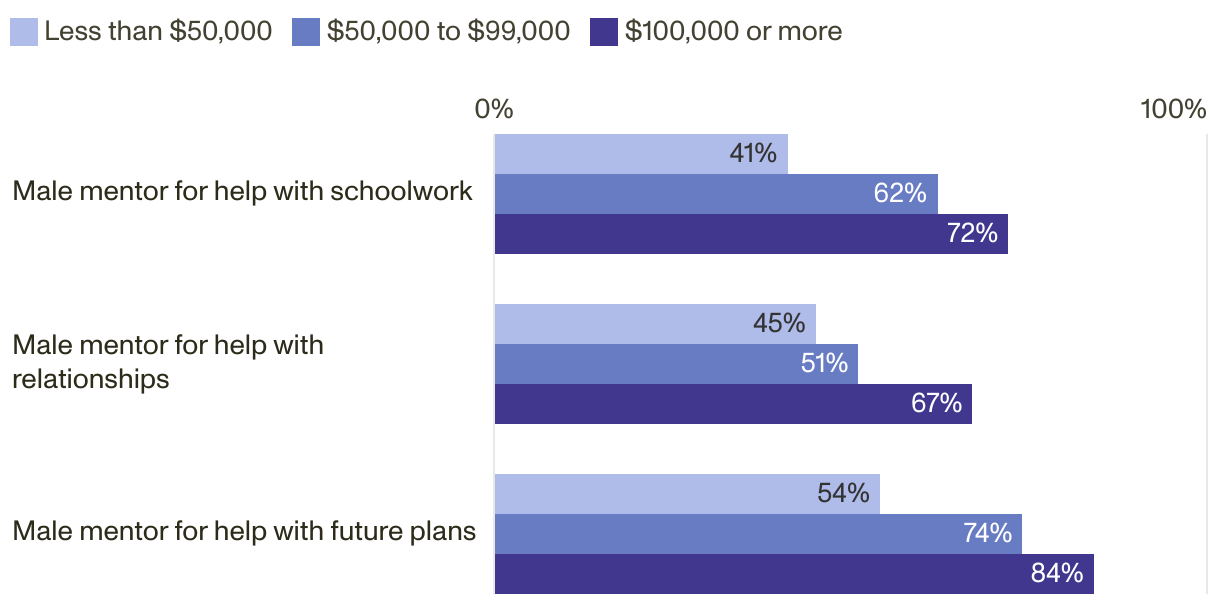
Lastly, our data show that access to adult male mentors is limited for boys and young men from households facing economic challenges, consistent with the fact that female-headed households are more likely to have lower incomes than male-headed or married-couple households. This disparity is illustrated in Figure 2, where we show the percentage of boys and young men who have a male mentor across three levels of annual household income: less than $50,000, $50,000 to $99,000, and $100,000 or more. We had valid data on household income for 1,074 of the 1,083 boys and young men in our sample. For each life domain, boys and young men in the lowest income bin are considerably less likely to have an adult male mentor than their peers in the higher income bins. Fewer than half of boys and young men from households earning less than $50,000 have a male mentor for schoolwork or for relationships, compared with more than two-thirds of boys and young men from households with earnings of $100,000 or more.
Figure 2. Percentage of Boys and Young Men (Ages 12–21) Who Reported Having a Male Mentor, by Household Income
- Male mentor for help with schoolwork
- Less than $50,000: 41%
- $50,000 to $99,000: 62%
- $100,000 or more: 72%
- Male mentor for help with relationships
- Less than $50,000: 45%
- $50,000 to $99,000: 51%
- $100,000 or more: 67%
- Male mentor for help with future plans
- Less than $50,000: 54%
- $50,000 to $99,000: 74%
- $100,000 or more: 84%
SOURCE: Authors’ analysis of RAND American Life Panel and Ipsos KnowledgePanel survey data, May 2025; n = 1,074.
Appendix A. Data Used in This Report
Tables 1 and 2 provide the data presented in Figures 1 and 2, including standard errors, confidence intervals, and sample sizes.
Table 1. Presence of Mentors for Boys and Young Men Ages 12–21
| % | Standard Error | 95% Confidence Interval | n | ||
|---|---|---|---|---|---|
| Lower Bound | Upper Bound | ||||
| Help with school | |||||
| Any mentor | 93.6% | 1.3% | 90.6% | 95.7% | 1,083 |
| Female mentor | 77.9% | 1.8% | 74.1% | 81.2% | 1,083 |
| Male mentor | 62.0% | 1.9% | 58.1% | 65.7% | 1,083 |
| Help with relationships | |||||
| Any mentor | 88.0% | 1.6% | 84.6% | 90.7% | 1,083 |
| Female mentor | 78.2% | 1.8% | 74.5% | 81.6% | 1,083 |
| Male mentor | 57.3% | 2.0% | 53.3% | 61.1% | 1,083 |
| Help with future plans | |||||
| Any mentor | 95.9% | 1.0% | 93.5% | 97.4% | 1,083 |
| Female mentor | 84.8% | 1.5% | 81.5% | 87.6% | 1,083 |
| Male mentor | 73.7% | 1.9% | 69.9% | 77.1% | 1,083 |
Table 2. Presence of Male Mentors for Boys and Young Men Ages 12–21, by Household Income
| % | Standard Error | 95% Confidence Interval | n | ||
|---|---|---|---|---|---|
| Lower Bound | Upper Bound | ||||
| Help with school | |||||
| Less than $50k | 40.8% | 4.2% | 32.8% | 49.2% | 213 |
| $50k to $99k | 62.2% | 3.7% | 54.7% | 69.2% | 263 |
| $100k or more | 72.3% | 2.5% | 67.2% | 76.8% | 598 |
| Help with relationships | |||||
| Less than $50k | 44.8% | 4.3% | 36.5% | 53.4% | 213 |
| $50k to $99k | 51.4% | 3.9% | 43.7% | 59.0% | 263 |
| $100k or more | 67.5% | 2.5% | 62.3% | 72.2% | 598 |
| Help with future plans | |||||
| Less than $50k | 53.9% | 4.4% | 45.3% | 62.2% | 213 |
| $50k to $99k | 73.9% | 3.6% | 66.3% | 80.3% | 263 |
| $100k or more | 84.1% | 2.2% | 79.4% | 87.9% | 598 |
Appendix B. Question Wording of Survey Items Used in This Report
When you have problems with schoolwork, is there an adult you could turn to for help? Select all that apply
- ❑ Yes, my mom
- ❑ Yes, my dad
- ❑ Yes, an adult who is not my parent
- ❍ No, I could not turn to an adult if I had problems with schoolwork
[Ask if the adult is not a parent] Think about the adult you would turn to most often who isn’t your parent. Is this adult a man or a woman? Select one response
- ❍ Man
- ❍ Woman
When you have friendship or relationship problems, is there an adult you could turn to for help? Select all that apply
- ❑ Yes, my mom
- ❑ Yes, my dad
- ❑ Yes, an adult who is not my parent
- ❍ No, I could not turn to an adult if I had friendship or relationship problems
[Ask if the adult is not a parent] Think about the adult you would turn to most often who isn’t your parent. Is this adult a man or a woman? Select one response
- ❍ Man
- ❍ Woman
When you think about your future, is there an adult that you could turn to for advice? Select all that apply
- ❑ Yes, my mom
- ❑ Yes, my dad
- ❑ Yes, an adult who is not my parent
- ❍ No, I could not turn to an adult for advice about my future
[Ask if the adult is not a parent] Think about the adult you would turn to most often who isn’t your parent. Is this adult a man or a woman? Select one response
- ❍ Man
- ❍ Woman
References
- Emmott, Emily H., and Ruth Mace, “Why the Son-Bias in Caregiving? Testing Sex-Differences in the Associations Between Paternal Caregiving and Child Outcomes in England,” Journal of Family Issues, Vol. 42, No. 6, June 2021.
- Foster-Bey, John, Nathan Dietz, and Robert Grimm, Jr., Volunteers Mentoring Youth: Implications for Closing the Mentoring Gap, Corporation for National and Community Service, May 2006.
- Garringer, Michael, and Chelsea Benning, Who Mentored You? A Study Examining the Role Mentors Have Played in the Lives of Americans over the Last Half Century, MENTOR: National Mentoring Partnership, 2023.
- Ipsos, “KnowledgePanel® Sample Representativeness & Related Topics,” undated. As of October 30, 2025: https://www.ipsos.com/sites/default/files/KnowledgePanel-Representativeness-2025.pdf
- Juteau, Gabrielle, “Age Variation in Singlehood from Young to Midlife Adulthood, 2022,” National Center for Family and Marriage Research, Family Profile FP-23-11, 2023.
- Kraft, Matthew A., Alexander J. Bolves, and Noelle M. Hurd, “How Informal Mentoring by Teachers, Counselors, and Coaches Supports Students’ Long-Run Academic Success,” Economics of Education Review, Vol. 95, August 2023.
- Loo, Jaden, “Young Adults in the Parental Home, 2007-2023,” National Center for Family and Marriage Research, Family Profile FP-24-02, 2024.
- Pollard, Michael, and Matthew D. Baird, The RAND American Life Panel: Technical Description, RAND Corporation, RR-1651, 2017. As of October 30, 2025: https://www.rand.org/pubs/research_reports/RR1651.html
- Raposa, Elizabeth B., Jean Rhodes, Geert Jan J. M. Stams, Noel Card, Samantha Burton, Sarah Schwartz, Laura A. Yoviene Sykes, Stella Kanchewa, Janis Kupersmidt, and Saida Hussain, “The Effects of Youth Mentoring Programs: A Meta-Analysis of Outcome Studies,” Journal of Youth and Adolescence, Vol. 48, 2019.
- Reeves, Richard V., Of Boys and Men: Why the Modern Male Is Struggling, Why It Matters, and What to Do About It, Brookings Institution Press, 2022.
- Reeves, Richard V., and Will Secker, “Male Suicide: Patterns and Recent Trends,” American Institute for Boys and Men, November 17, 2023.
- Sarkadi, Anna, Robert Kristiansson, Frank Oberklaid, and Sven Bremberg, “Fathers’ Involvement and Children’s Developmental Outcomes: A Systematic Review of Longitudinal Studies,” Acta Paediatrica, Vol. 97, No. 2, February 2008.
- Spencer, Renée, Alison L. Drew, Jill Walsh, and Stella S. Kanchewa, “Girls (and Boys) Just Want to Have Fun: A Mixed-Methods Examination of the Role of Gender in Youth Mentoring Relationship Duration and Quality,” Journal of Primary Prevention, Vol. 39, 2018.
- Tierney, Joseph P., Jean B. Grossman, and Nancy L. Resch, Making a Difference: An Impact Study of Big Brothers Big Sisters, Public/Private Ventures, November 1995.
- U.S. Census Bureau, “American Community Survey (ACS),” webpage, last revised September 29, 2025. As of November 3, 2025: https://www.census.gov/programs-surveys/acs
- Wenger, Jennie W., and Stephanie Bonds, Understanding Disconnection Among American Youth, RAND Corporation, PE-A4207-1, October 2025. As of October 1, 2025: https://www.rand.org/pubs/perspectives/PEA4207-1.html
Topics
Document Details
- Copyright: RAND Corporation
- Availability: Web-Only
- Year: 2025
- DOI: https://doi.org/10.7249/RRA4451-1
- Document Number: RR-A4451-1
Citation
RAND Style Manual
Chicago Manual of Style
Research conducted by
Funding for this research was provided by gifts from RAND supporters and income from the operation of RAND Survey Panels. This work was conducted by RAND Education, Employment, and Infrastructure.
This publication is part of the RAND research report series. Research reports present research findings and objective analysis that address the challenges facing the public and private sectors. All RAND research reports undergo rigorous peer review to ensure high standards for research quality and objectivity.
This document and trademark(s) contained herein are protected by law. This representation of RAND intellectual property is provided for noncommercial use only. Unauthorized posting of this publication online is prohibited; linking directly to this product page is encouraged. Permission is required from RAND to reproduce, or reuse in another form, any of its research documents for commercial purposes. For information on reprint and reuse permissions, please visit www.rand.org/pubs/permissions.
RAND is a nonprofit institution that helps improve policy and decisionmaking through research and analysis. RAND's publications do not necessarily reflect the opinions of its research clients and sponsors.