

Project
Survey Panels
Feb 28, 2024
ResearchPublished Nov 6, 2025
As evidenced during the coronavirus pandemic, how humans perceive and react to risk has significant consequences. Therefore, understanding public perceptions of global catastrophes could help the U.S. government set priorities for preparing the country and protecting it from such catastrophes (Parker, 2022).
In this brief report, we present the public’s perceptions of six categories of risk using data from a survey fielded to a nationally representative sample of 8,793 adults from the RAND American Life Panel. The results reflect respondents’ perceptions of risks posed by artificial intelligence (AI), asteroids and comets hitting Earth, severe changes to Earth’s climate, nuclear war, severe pandemics, and supervolcanoes.
Members of the panel are drawn using probability sampling methods, and the data are weighted to reflect the demographic diversity of the U.S. population. The survey was fielded in May and June 2025. Note that the survey took place before June 21, 2025, when the United States launched a military strike on Iran’s nuclear facilities.
Readers should interpret our findings with caution because perceptions of the risk of nuclear war may have been altered by this event. All of the data presented in the figures, as well as standard errors, confidence intervals, and sample sizes, can be found in the appendix.
We asked panel members to report their level of concern about six threats and hazards that could pose risks of global catastrophe. We offered three options in their evaluations of each risk: (1) very concerned, (2) somewhat concerned, and (3) not concerned. Figure 1 shows that U.S. adults are most concerned about harms from AI, with 81 percent reporting that they were either very or somewhat concerned. After AI, the threats and hazards generating the most concern were nuclear war, severe pandemics, and severe changes to Earth’s climate.

Axes are labeled from 0% to 100% in increments of 25%.
SOURCE: Authors' analysis of RAND American Life Panel survey data, May–June 2025.
NOTE: n = 8,793.
Next, we asked panel members the following question: “How do you believe the risks from the following threats or hazards are changing?” We gave panel members three options: (1) increasing, (2) neither increasing nor decreasing, and (3) decreasing. Results from this question are shown in Figure 2.
A majority of adults perceive that risks from the three threats and hazards induced by human activity are increasing: 76 percent believe that the risk of harms from AI is increasing, 64 percent believe that the risk of severe changes to Earth’s climate is increasing, and 53 percent believe that the risk of nuclear war is increasing. In results not shown, less than 10 percent of U.S. adults responded that the risk of any of the six threats and hazards is decreasing.
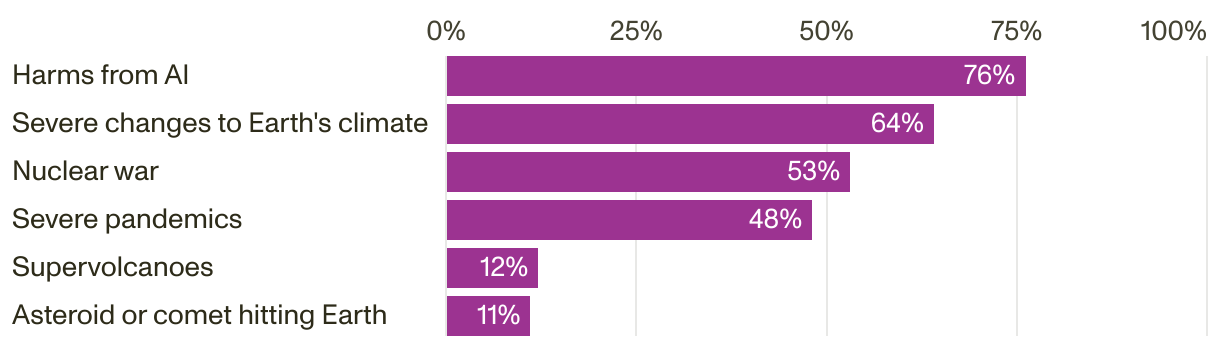
SOURCE: Authors' analysis of RAND American Life Panel survey data, May–June 2025.
NOTE: n = 8,793.
Tables 1 and 2 provide data used in the corresponding figures in this report.
| Weighted Percentage of U.S. Adults | Standard Error | 95% Confidence Interval | n | ||
|---|---|---|---|---|---|
| Lower Bound | Upper Bound | ||||
| Asteroid or comet hitting Earth | |||||
| Not concerned | 69.4 | 0.8 | 67.9 | 70.9 | 6,511 |
| Somewhat concerned | 23.2 | 0.7 | 21.9 | 24.6 | 1,845 |
| Very concerned | 7.4 | 0.0 | 6.5 | 8.4 | 437 |
| Supervolcanoes | |||||
| Not concerned | 70.1 | 0.8 | 68.5 | 71.6 | 6,489 |
| Somewhat concerned | 22.4 | 0.7 | 21.1 | 23.8 | 1,862 |
| Very concerned | 7.5 | 0.5 | 6.6 | 8.6 | 440 |
| Harms from AI | |||||
| Not concerned | 18.7 | 0.7 | 17.4 | 20.1 | 1,501 |
| Somewhat concerned | 56.2 | 0.8 | 54.6 | 57.8 | 5,132 |
| Very concerned | 25.1 | 0.7 | 23.7 | 26.5 | 2,159 |
| Severe pandemics | |||||
| Not concerned | 25.4 | 0.7 | 24.0 | 26.8 | 2,248 |
| Somewhat concerned | 49.4 | 0.8 | 47.8 | 51.0 | 4,568 |
| Very concerned | 25.2 | 0.7 | 23.8 | 26.7 | 1,976 |
| Nuclear war | |||||
| Not concerned | 24.2 | 0.7 | 22.8 | 25.5 | 2,233 |
| Somewhat concerned | 49.2 | 0.8 | 47.6 | 50.9 | 4,623 |
| Very concerned | 26.6 | 0.8 | 25.1 | 28.1 | 1,937 |
| Severe changes to Earth's climate | |||||
| Not concerned | 28.4 | 0.7 | 27.0 | 29.9 | 2,603 |
| Somewhat concerned | 39.1 | 0.8 | 37.5 | 40.7 | 3,486 |
| Very concerned | 32.5 | 0.8 | 31.0 | 34.0 | 2,704 |
| Weighted Percentage of U.S. Adults | Standard Error | 95% Confidence Interval | n | ||
|---|---|---|---|---|---|
| Lower Bound | Upper Bound | ||||
| Asteroid or comet hitting Earth | |||||
| Increasing risk | 11.3 | 0.5 | 10.3 | 12.4 | 828 |
| Stable risk | 82.6 | 0.7 | 81.2 | 83.9 | 7,540 |
| Decreasing risk | 6.1 | 0.5 | 5.3 | 7.1 | 417 |
| Supervolcanoes | |||||
| Increasing risk | 12.2 | 0.6 | 11.1 | 13.3 | 941 |
| Stable risk | 80.1 | 0.7 | 78.6 | 81.4 | 7,315 |
| Decreasing risk | 7.8 | 0.5 | 6.9 | 8.8 | 532 |
| Harms from AI | |||||
| Increasing risk | 76.0 | 0.8 | 74.5 | 77.4 | 7,017 |
| Stable risk | 22.3 | 0.7 | 20.9 | 23.7 | 1,675 |
| Decreasing risk | 1.8 | 0.3 | 1.2 | 2.5 | 93 |
| Severe pandemics | |||||
| Increasing risk | 47.5 | 0.8 | 45.9 | 49.2 | 4,270 |
| Stable risk | 47.6 | 0.8 | 46.0 | 49.2 | 4,157 |
| Decreasing risk | 4.8 | 0.4 | 4.2 | 5.6 | 359 |
| Nuclear war | |||||
| Increasing risk | 53.3 | 0.8 | 51.7 | 54.9 | 4,633 |
| Stable risk | 43.2 | 0.8 | 41.6 | 44.8 | 3,858 |
| Decreasing risk | 3.5 | 0.3 | 3.0 | 4.1 | 296 |
| Severe changes to Earth's climate | |||||
| Increasing risk | 64.2 | 0.8 | 62.7 | 65.8 | 5,674 |
| Stable risk | 32.9 | 0.8 | 31.4 | 34.4 | 2,877 |
| Decreasing risk | 2.9 | 0.3 | 2.4 | 3.5 | 236 |
Funding for this research was provided by gifts from RAND supporters and income from the operation of RAND Survey Panels. This work was conducted by RAND Education, Employment, and Infrastructure.
This publication is part of the RAND research report series. Research reports present research findings and objective analysis that address the challenges facing the public and private sectors. All RAND research reports undergo rigorous peer review to ensure high standards for research quality and objectivity.
This document and trademark(s) contained herein are protected by law. This representation of RAND intellectual property is provided for noncommercial use only. Unauthorized posting of this publication online is prohibited; linking directly to this product page is encouraged. Permission is required from RAND to reproduce, or reuse in another form, any of its research documents for commercial purposes. For information on reprint and reuse permissions, please visit www.rand.org/pubs/permissions.
RAND is a nonprofit institution that helps improve policy and decisionmaking through research and analysis. RAND's publications do not necessarily reflect the opinions of its research clients and sponsors.
